Violaeon

EV thermal & energy management
Battery pack design, simulation & engineering

Two disciplines, one team: EV thermal & energy management, and battery-pack design, simulation and engineering. “We need a battery pack” is the most expensive sentence in product development — not because the pack is hard, but because the sentence hides every decision that costs money. We turn it into a spec your suppliers can quote and your certifier can accept.
01 · EV thermal & energy managementSystem modelling, control and validation
02 · Battery pack design, simulation & engineeringConcept, packaging, thermal, cost model
CertificationECE R100 · EU Battery Passport · UN 38.3 · IEC 62619
01

EV thermal & energy management

Design, modelling, control and validation built around thermal, energy and lifetime requirements. Four capabilities, then three examples of them in use.

01

Systems & component development

Heat pumps, coolant loops, integrated heat exchangers and thermal storage.

02

Structural topology optimisation

Material and flow-channel layout optimisation, including cold-plate channels.

03

Multi-level testing & evaluation

Component test benches, HIL, vehicle duty cycles and reliability testing.

04

Thermal & energy management

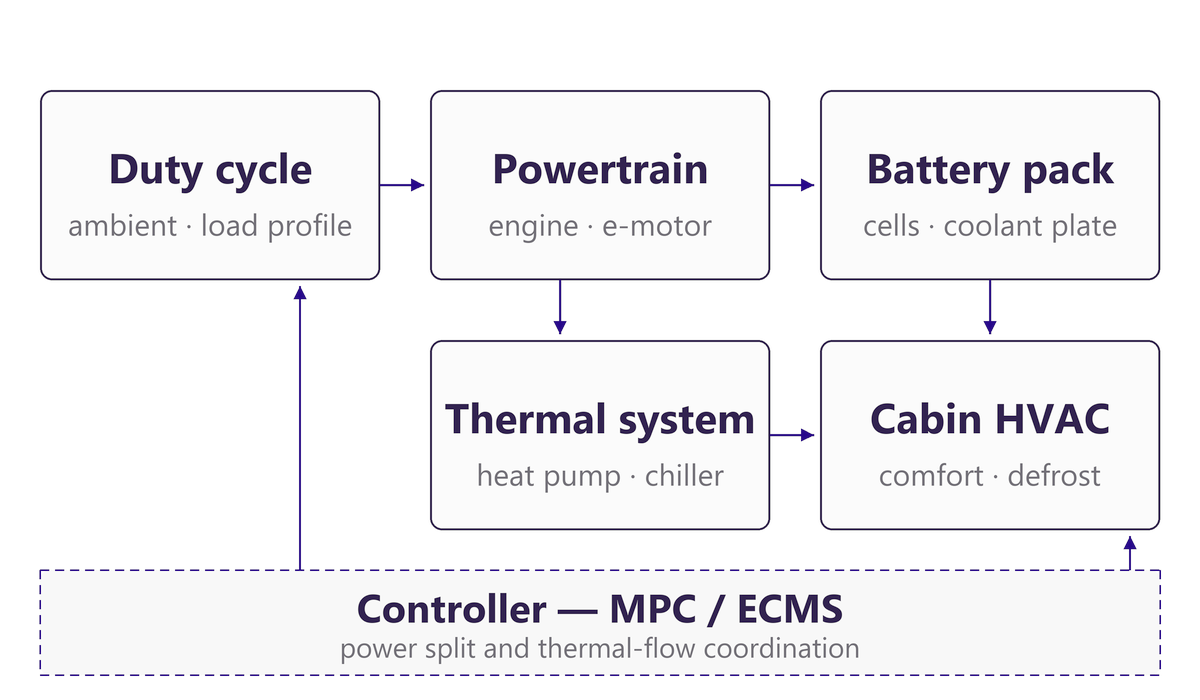
Electro-mechanical-thermal coupling, power split and coordinated thermal control.

Examples · three programmes

Example 01

Modelling & validation platform

  • 1D system and 3D flow/thermal models calibrated against measured data — component calibration, system coupling and multi-condition test correlation.
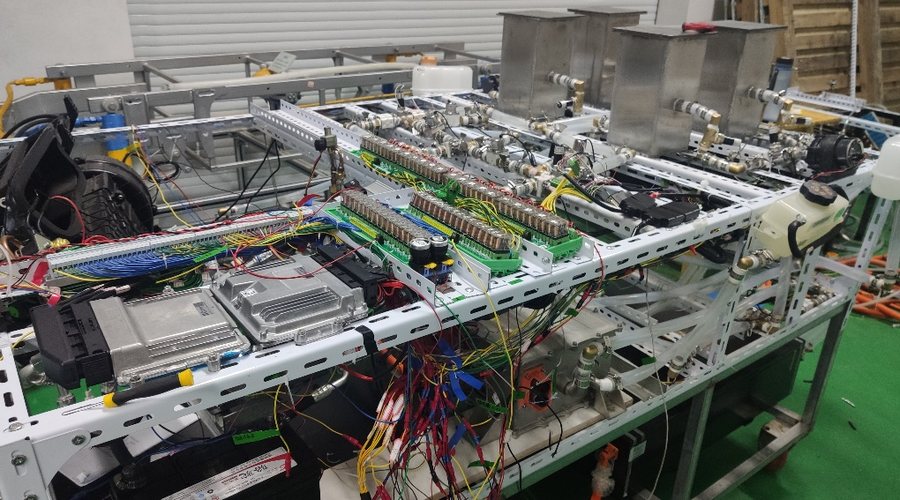
  • Rapid prototyping and hardware-in-the-loop for real-time control-strategy evaluation — dSPACE / MicroAutoBox / HIL.
  • Component test benches, vehicle duty cycles and reliability testing.
Example 02

Thermal & energy management control

  • System and battery-state models fused to co-ordinate propulsion power with thermal actuators.
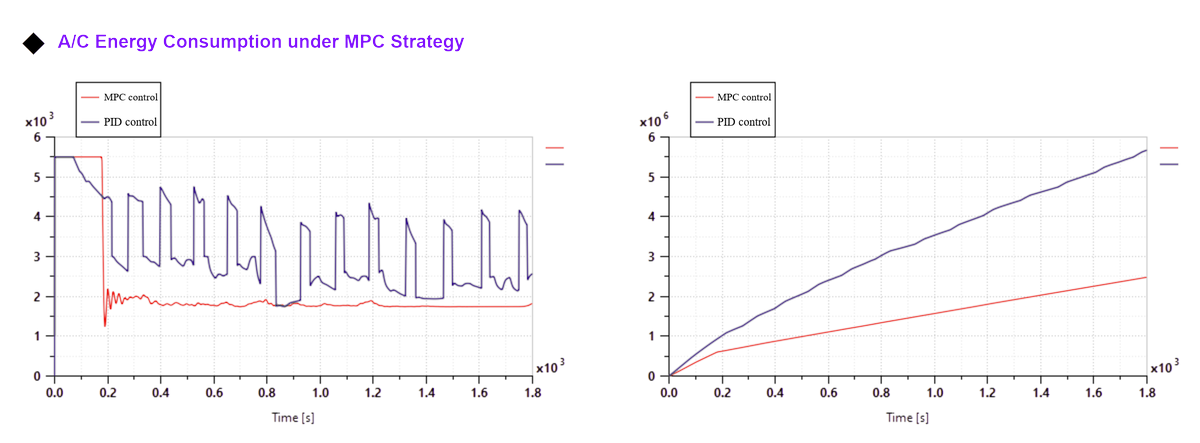
  • MPC and ECMS strategies benchmarked against a baseline controller in co-simulation.
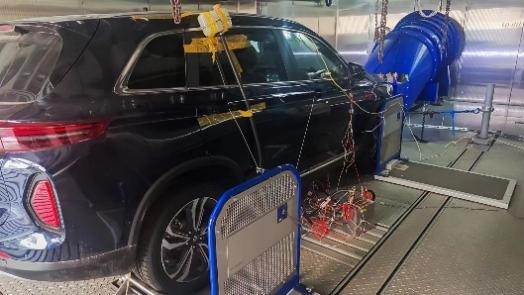
  • Layered evaluation: model simulation, HIL and vehicle test, with performance and real-time capability judged separately.
Example 03 · thermal & energy management · hybrid vehicle

Hybrid-vehicle thermal management co-development

  • System model built and calibrated against bench and vehicle measurements.
  • Component concept matched to the thermal duty cycle — compressors, valves, coolant loops and heat exchangers.
  • Coordinated control strategy across power split and thermal flow, assessed on a vehicle-level environmental cycle.
~6.8%

lower equivalent fuel consumption versus the baseline strategy on a −10 °C CWTVC cycle, with start/end SOC corrected. Co-ordinated strategy 2.42 L vs baseline 2.60 L.

The lesson isn’t the number — the compressors, valves and coolant loops were already there. At that stage most thermal problems aren’t component problems. They’re coordination problems.

Test conditions: −10 °C, CWTVC; equivalent fuel consumption corrected for start/end SOC. Client engagement anonymised; figure shared with permission.

02

Battery pack design, simulation & engineering

From a fuzzy pack request to a buildable, costed and certifiable specification. Five service scopes, then two examples of them in use.

01

Feasibility & concept

Cell selection and architecture trade-offs, packaging envelope, voltage and energy targets, cost model.

You get: a target spec your suppliers can quote against.
02

Certification pathway

Applicable regulations, test plan, lab options, timeline and budget — UN R100 / R10 / UN 38.3 / IEC 62619 / EU 2023/1542.

You get: a dated, costed route to market.
03

Thermal & duty-cycle assessment

Cooling concept, duty-cycle loads, lifetime and SOH estimate, margin where it actually matters.

You get: a thermal concept with stated margin — not a single number.
04

Integration

BMS-to-vehicle interface, CAN / DBC definition, fault tree and commissioning plan.

You get: interface documents a supplier can actually build to.
05

Performance modelling & validation

ECM parameter identification and SOC / SOH estimation, validated on an independent duty cycle.

You get: a model and parameter set with its validity range written down.

Examples · two programmes

Example 01

Feasibility & concept

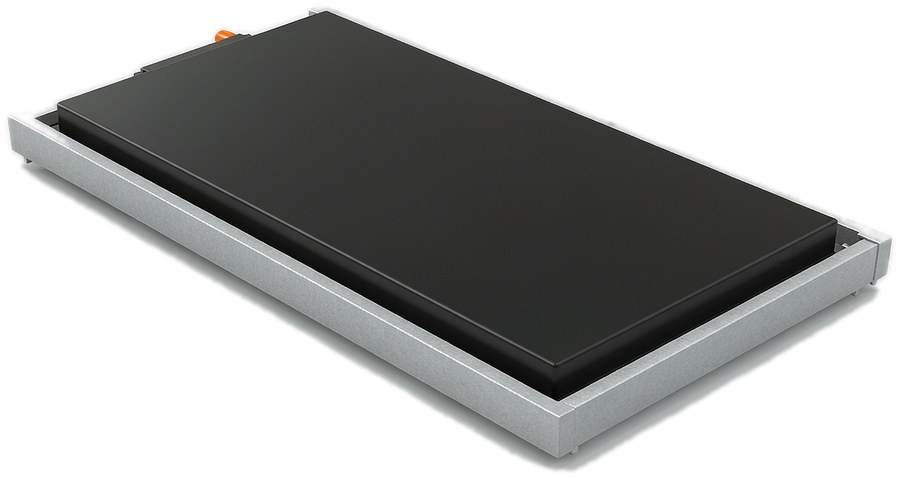
Illustrative render of an electric-vehicle traction battery pack: a flat sealed cover in a slim aluminium frame, with the high-voltage connector at one end.

Illustrative pack architecture — generated render, not a client pack.

  • Cell selection — chemistry, format and suppliers screened against duty cycle and cost.
  • Architecture trade-offs — series / parallel layout, module strategy and integration options compared.
  • Packaging envelope — volume, mass and crash envelope checked against the host vehicle.
  • Voltage and energy targets — usable energy, peak power and SOC window defined and traced.
  • Cost model — bill-of-material and process cost drivers, with the sensitivity that matters.
Example 02

Battery performance modelling & validation

  • ECM parameter identification from test data, validated across temperature.
  • SOC and SOH estimation checked on an independent duty cycle, with the validity boundary stated explicitly.
  • Physics-informed neural surrogate trained on simulation and bench data — simulation-grade results at a fraction of the run time.

How we work

  1. Diagnostic interview — 30 minutes to find out whether it can be built and what it will take.
  2. Concept spec — architecture, cost model, certification path, risk list.
  3. Supplier shortlist — who can actually quote this, and what they’ll need from you.
  4. Design review — we stay on your side of the table while suppliers bid.

About

Located in Shanghai, Violaeon is an independent battery-pack engineering practice, working with manufacturers in Europe and North America who are too small for a tier-1’s attention and too specialised for a standard pack.
Two disciplines, one team

EV thermal & energy management, and battery pack design, simulation and engineering — the pack and the system around it assessed together.

Process

Development follows APQP and VDA processes and meets target-market legislation — ECE R100, the EU Battery Passport and US automotive requirements.

Working model

A part-time pack-engineering partner: diagnostic interview → spec → supplier shortlist → design review. Remotely with EU and US clients.